

Heat Pump Noise Control
A heat pump should keep a building comfortable without making nearby rooms or outdoor spaces difficult to enjoy. We develop acoustic screens, ventilated enclosures and room treatments around the equipment and the way sound reaches people. The first step is to distinguish airborne noise from vibration travelling through the installation.
Start With What You Hear
A steady outdoor fan sound, a low hum in a bedroom and a short change during defrost can point to different issues. Where and when the noise is noticeable helps determine what to investigate.
Sound across a courtyard or boundary
Review the outdoor unit, its orientation, nearby reflective surfaces and the line of sight to affected windows.
A hum through a wall or floor
Inspect mounts, brackets, pipe supports and penetrations for vibration transmission.
A new rattle or scraping sound
Arrange an equipment inspection before treating it as an acoustic design problem.
The treatment can then target the main source and transmission path, with heating, cooling and service requirements built into the design.
Match The Solution To The Heat Pump System
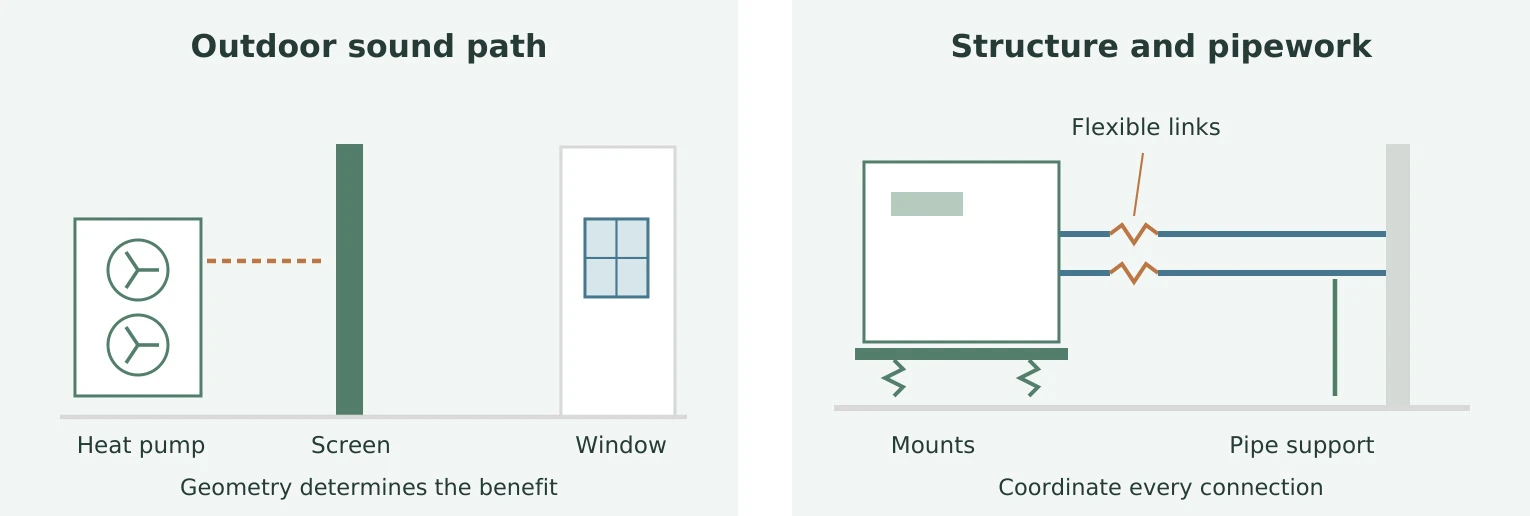
Two paths to assess separately. A screen treats an outdoor sound path; isolation addresses vibration through supports and connections.
Air Source Heat Pumps
Air source heat pump noise reduction usually focuses on the outdoor fan, compressor and mounting arrangement. A screen can interrupt sound towards a particular location. A purpose-designed enclosure can treat more of the airborne sound, but its air paths must be sized for the unit. Air source heat pump noise control must retain clear intake and discharge routes, defrost drainage and maintenance access.
Select the layout against the manufacturer's installation requirements, including those relating to the refrigerant. Avoid an arrangement that sends discharged air back into the intake. A cover that merely hides the unit is not necessarily an acoustic treatment.
Water Source Heat Pumps
Water source heat pump noise control depends on the unit type and location. Indoor compressors, circulation pumps and connected pipework may transmit sound into adjacent spaces. Water-to-air units also have fans and ducts to consider. For water source heat pump noise reduction, coordinate casing or room treatment with suitable mounts, flexible water connections and supported pipework. Treat duct paths where they contribute to the complaint.
Ground Source And Geothermal Systems
Ground source heat pump noise control generally focuses on the heat pump, circulation equipment and building connections. Many ground-loop installations use water-to-water or water-to-air units, so the acoustic approach overlaps with water source systems. The buried loop itself has no fan or compressor.
For geothermal heat pump noise reduction, trace how machinery sound reaches occupied rooms before selecting treatment. Geothermal heat pump soundproofing may include acoustic doors, sealed penetrations and room absorption, alongside vibration isolation. Room finishes alone will not correct vibration carried through a rigid pipe or structural connection.
Fit The Treatment Around Year-Round Operation
An acoustic package needs to work under the conditions that cause the complaint. Record the operating mode and load alongside noise measurements. For air source systems, include cold-weather heating and defrost behaviour where relevant; for indoor systems, note which compressors and circulation pumps run together.
Airflow And Access
Enclosure dimensions, ventilation openings and attenuators are selected together. Keep air routes, drains, controls and service panels accessible. Confirm that added airflow resistance is acceptable for the equipment, and allow panels to be removed without dismantling the installation.
Mounts And Connections
Choose isolation for the equipment load, operating characteristics and supporting structure. Coordinate the pipes and their supports so rigid connections do not bypass it. Existing factory mounts and manufacturer instructions should be reviewed before adding or changing isolation.
A Target Linked To The Affected Location
Set the acoustic target at the room, window or boundary that needs protection. Confirm the conditions behind the equipment's sound data. Sound power describes the source; sound pressure depends on the measurement position and surroundings. The two ratings cannot be compared as if they were the same value.
Common questions
Choosing A Screen Or An Enclosure
A screen may suit one dominant direction of sound travel. An enclosure can address more directions, but adds requirements for airflow, access and equipment compatibility. Both need a layout based on the source and the affected location.
Using Quiet Mode At Night
Where available, quiet mode may help during sensitive hours. Check its effect on heating or cooling capacity with the equipment supplier. It does not replace an assessment of vibration or of operation when full output is required.
Investigating A Hum Inside The Building
An outdoor screen may have little effect if the dominant path is structural. Check brackets, bases, pipe supports and wall penetrations, as well as airborne paths. The location of the source alone does not identify how the sound enters the room.
Preparing An Initial Proposal
Send the heat pump model and quantity, layout, photos, mounting details and affected locations. Include operating modes, the times the noise is noticeable, any noise report and the manufacturer's clearance requirements. These details help us define a treatment scope and agree how its performance will be checked.