

 Concept illustration of a centrifugal fan installation with ductwork and acoustic treatment.
Fan and Ventilation Noise Control
A fan can meet its airflow requirement and still make a nearby workspace or property uncomfortable. Effective industrial fan noise control starts by finding how the sound reaches that location. We plan silencers, enclosures and vibration treatment around the noise path while keeping ventilation and maintenance needs in view.
Find The Path Before Choosing The Treatment
Noise heard at an outlet may need a different solution from a rumble through the floor. For industrial fan noise reduction, we check the fan, connected ducts and nearby spaces as one system.
|
Where the noise is heard |
What to investigate |
Possible treatment |
|
At an inlet, outlet or grille |
Sound carried through the air path |
Duct or inlet and outlet silencers |
|
Around the fan or plant room |
Casing radiation, doors and openings |
Acoustic enclosure or room treatment |
|
Through floors, walls or supports |
Vibration through rigid connections |
Selected mounts and flexible connections |
A sudden change in sound can also signal an equipment problem. Check fouling, imbalance, worn bearings and loose parts before designing an acoustic retrofit.
Match The Treatment To The Equipment
A ventilation fan, a positive displacement blower and an air handling unit do not need the same package. We assess the dominant frequencies, airflow route and operating duty before deciding which components to supply.
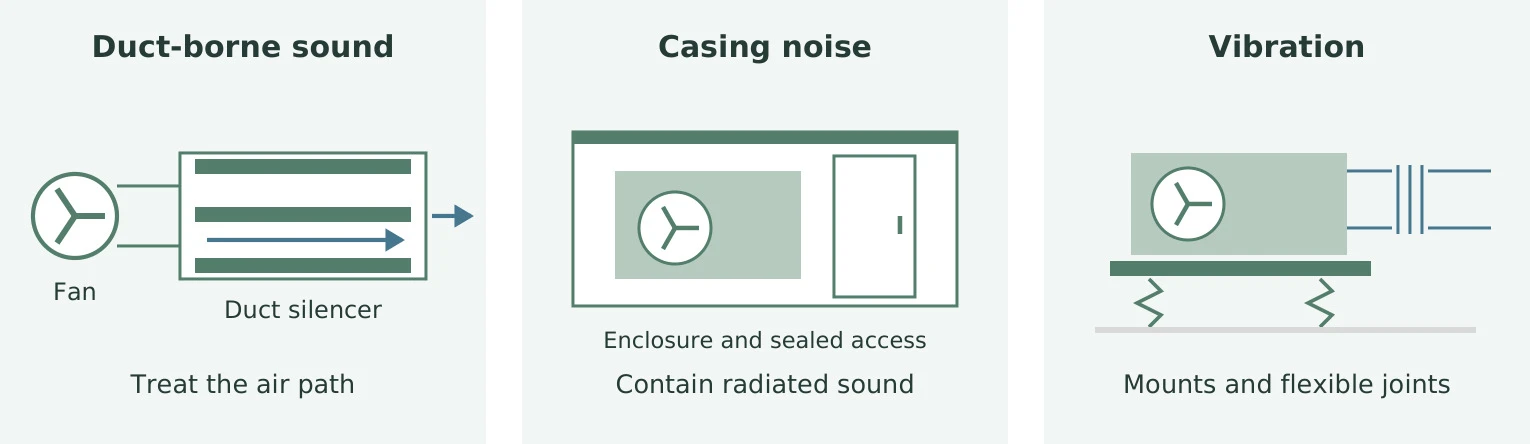
Three transmission paths with different treatments. This is a principle diagram, not an installation drawing.
Centrifugal Fans
For centrifugal fan noise reduction, review the inlet and discharge separately. Disturbed airflow near bends or abrupt transitions can add noise and reduce performance. Centrifugal fan noise control may combine duct silencers with casing treatment and isolation, selected after checking the fan duty and available space.
01
Roots Blowers
Roots blower noise reduction must account for pressure pulsation as well as sound from the casing and drive. Roots blower noise control may require purpose-designed inlet and discharge silencers, an acoustic enclosure and vibration isolation. Silencers must suit the operating pressure, temperature and gas stream; a standard ventilation attenuator is not a universal substitute.
02
Air Handling Units
Air handling unit noise control addresses sound travelling along supply and return ducts, sound radiated from the casing and vibration through supports. For AHU noise reduction, coordinate attenuators and connections with filter access, cleaning requirements and the unit's available fan pressure.
03
Smoke Extract Systems
Smoke extract fan noise control must preserve the required smoke extraction duty. When planning smoke exhaust fan noise reduction, confirm the temperature and duration requirements, pressure allowance and suitability of every added component with the system designer. Assess normal ventilation and emergency operation separately where the fan serves both modes.
04
Fan Rooms
Fan room noise control considers the complete room, including doors, ventilation openings, duct penetrations and structural connections. Fan room soundproofing may combine sealed construction with internal absorption and treated air paths. Absorptive wall lining alone will not stop sound escaping through an untreated opening.
05
Specify Noise Reduction And Airflow Together
A silencer has to do more than fit the duct. We compare the required reduction at each frequency with the airflow, allowable pressure loss and noise generated by air passing through the silencer itself. Its position matters too: nearby fittings and uneven flow can change installed performance.
An enclosure must also allow the motor and enclosed equipment to cool. Doors, removable panels and lifting access should be planned before fabrication so routine service remains practical.
Information for a useful proposal
Equipment and duty
Fan or blower model, quantity, speed range, airflow, operating pressure and normal operating schedule.
Acoustic target
Affected locations, noise measurements and any frequency data, plus the target for the room or property boundary.
Installation
Layout, photos, duct dimensions, available straight lengths, supports and maintenance clearances.
Service conditions
Temperature, moisture, dust, corrosive media, cleaning needs and any smoke extraction requirements.
These inputs help define the treatment scope, dimensions, materials, pressure allowance and installation interfaces. Agree how noise and airflow will be checked after installation, with the equipment running under representative conditions.
Common Questions
Choosing Between A Silencer And An Enclosure
A silencer treats sound travelling through an air path. An enclosure contains airborne sound from the machine casing and drive. Some installations need both, with isolation added where vibration is significant.
Why A Low Rumble Can Remain After Treatment
The remaining sound may be low-frequency duct noise, structure-borne vibration or another untreated source. Check the frequency pattern and transmission path before adding more absorptive material or changing the silencer.
Retrofitting An Existing Installation
A retrofit is often possible, but space and available fan pressure can limit the options. We review the existing layout and maintenance needs before proposing dimensions or changes to the duct route.
Setting A Realistic Noise Target
The reduction achieved at a nearby room or boundary depends on all significant noise paths and other running equipment. A silencer's laboratory rating alone does not establish the final sound level at that location.
Discuss Your Fan Noise Problem
Send the equipment details, a layout and photos, and tell us where the noise is causing difficulty. We can review the likely paths and propose a package suited to the installation.